
Why Generators Still Anchor Off-Grid Construction Work
Power on construction sites has gotten more complicated over the last few years, what with electrification and renewable energy systems. There are more options than ever. But step outside your urban city onto a remote infrastructure project, and those options narrow quickly. Generators are still the primary power source for off-grid construction work. The alternatives haven’t caught up to what these sites actually demand. And the generator remains the one piece of equipment that can power a full construction operation without any external infrastructure.
Alternative power hasn’t caught up.
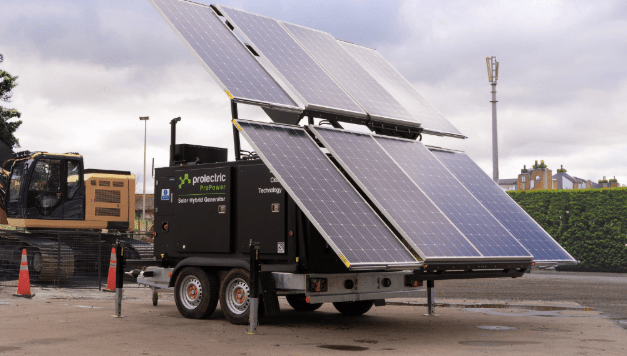
Solar hybrid systems work well in the right context. They’ll work for a site office and maybe a handful of low-draw devices. But a construction site running heavy plant works with high loads. We’re talking about compaction, water pumping, welding, and lighting across a large site area. The total draw is substantial, and it doesn’t follow a predictable pattern that solar generation handles well.
Now, battery storage can bridge the gap, but getting enough storage capacity to back up a full site isn’t something you can have in a remote location. It’s impractical for projects that need to move fast.
Generators don’t have that problem. They’re mobile and generate power the moment they start. And that’s precisely what you need on a remote site.
Getting the sizing right changes everything!
One of the more common mistakes on off-grid sites is treating generator sizing as a one-time decision at the start of a project. That won’t work because construction site load profiles change significantly across phases.
Early groundworks draw will be different from peak structural phase demand, which is different again from the final stage. A generator sized for peak demand runs inefficiently during lighter phases, burning through fuel at a much higher rate.
Smarter setups run generator sets in combination. A smaller unit handles baseload during lighter phases, with additional capacity brought on when demand increases. Modern generator control systems have made this easier to manage, with configurations that switch between setups automatically. The fuel savings are significant, especially on remote sites where fuel delivery is its own logistical challenge.
Power quality matters as much as capacity, too. Always remember, construction equipment is not forgiving of voltage instability. If compaction machines trip because of poor voltage, it causes a delay that eats into your schedule.
See also: How to Declutter Your Home Before Moving
Remote sites have no margin for power failures.
On a remote site that’s 80 or 90 kilometers from the nearest service point, any power issue is a whole event. There’s no backup supplier down the road. And every hour wasted has a cost that leaks across the whole crew and equipment schedule
.
A road infrastructure project running through desert terrain outside Abu Dhabi learned this the hard way. One of their project managers treated the generator specification as a secondary decision. He didn’t pay much heed to proper sizing or power quality.
And that manager had to pay for that. He got handed a failed concrete pour mid-process and voltage instability that damaged very expensive equipment. It also cost his work two weeks of delay. All of this due to one undersized unit.
On his next project, he knew not to make the same mistake. The power configuration was the first thing locked in. He made sure the site had a parallel generator setup, a primary unit on baseload, and a second unit available for peak phases. Fuel was also planned in its entirety before day one.
The project ran its full program without a single power stoppage. On a site that far from support, that outcome is the baseline around which the whole operation should be built.
Generators have evolved for exactly this kind of work.
The generator on a remote construction site today is not the same machine it was ten years ago. Newer models feature remote monitoring that automatically tracks fuel levels and engine health.
Imagine you’re running a site 80 kilometers from the nearest service point, and your generator develops a fault at the start of a night shift. With a modern generator management system, you can see the issue develop before it becomes a failure. You have time to switch to the backup unit or reduce the load. And if that doesn’t work, you can at least call for support before everything goes down.
Road recycling operations on remote projects work the same way. Processing existing road material on site makes sense logistically, but it also increases the power draw.
Modern generators handle that variable load without any instability, which is part of why on-site processing has become more effective on remote projects than it used to be.
The off-grid site still runs on generation.
Backhoe loaders, compaction plants, crushing equipment, and site services. Everything operating on a remote construction site draws from the same source. Until alternative power can get us that same level of sustained output and mobility, the generator remains central to how these sites operate. Nothing else works as well.

